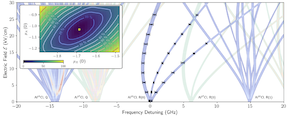
We report the measurement of the electric dipole moment of aluminum monochloride (AlCl) using a cryogenic buffer-gas beam source. Using Stark shift spectroscopy, we derive values for the dipole moments in the body-fixed frame of the two lowest vibrational states for the $X^1Σ^+$ electronic state, $μ_X(v’’=0) = -1.679$ D and $μ_X(v’’=1) = -1.761$ D, and for the $𝐴^1Π$ state, $μ_A(v’=0) = -1.030$ D and $μ_A(v’=1) = -1.052$ D. We also show that the ab initio calculations of the dipole moment and $T_e$ energy of AlCl are sensitive to the level of treatment of the spin-orbit orbit coupling. We further lay out the implications of these results for astrophysical models of stellar and planetary evolution that have used a substitute value for the dipole moment of AlCl until now.